

Predictive Artificial Intelligence
Apply predictive analytics, machine learning, and feature engineering to design data-driven solutions for business problems.
Course Overview
Master the practical use of predictive AI to solve real business problems. This hands-on course guides you through the full analytics workflow—from data collection and preparation to building, training, and deploying predictive analytical models. Explore key techniques like feature engineering, regression, and classification through real-world cases such as credit card fraud detection. Learn to communicate results clearly, build stakeholder trust, and lead impactful, data-driven initiatives in your organization.
Who is this virtual course for?
Mid-Level to Senior Professionals in roles like data science, analytics, business intelligence, product innovation, and technology leadership/consulting across industries such as finance, healthcare, retail, tech and manufacturing.
Tech leaders, Data Engineers, and Analysts seeking to upskill or pivot into AI-driven roles.
Data Scientists and Data Engineers looking to integrate predictive analytics and AI into their workflow.
Business Intelligence Analysts wanting to move from traditional reporting to more advanced predictive modeling.
Tech and Product Managers who oversee data-driven products and want to understand predictive capabilities.
Founders or Chief Technology Officers (CTOs) or Chief Data Officers (CDOs) seeking to lead AI transformation within their organizations.
Key Takeaways
Define predictive analytics and explain its benefits for business development and administration.
Identify the fundamental data types for predictive analytics and how to collect, prepare, and analyze data.
Build and evaluate predictive analytics models using popular tools, techniques, and forecasting methods.
Apply predictive analytics to solve real-world business problems.
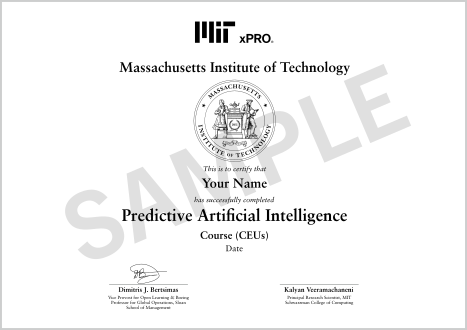
Certificate of Completion
All participants who successfully complete the Predictive Artificial Intelligence course will receive an MIT xPRO Certificate of Completion. In addition, they will earn 4.8 Continuing Education Units (MIT CEUs).
Participants are required to complete a CEU confirmation form based on the number of learning hours in each course to obtain CEUs.
Past Participant Profiles
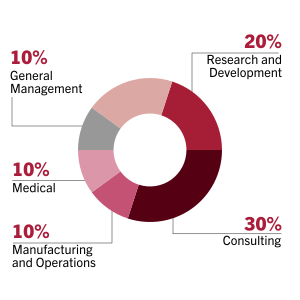
Diverse Functional Responsibilities
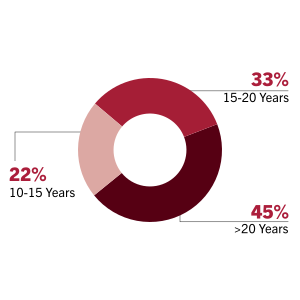
A Wide Range of Work Experience
Course Outline
Introduction to Predictive AI
Fundamental requirements for developing predictive AI
Data and its role in predictive AI
People and their roles in predictive AI development
Building predictive AI, step by step
Challenges and pitfalls
Looking ahead
Mapping a Business Outcome to Predictive AI
Action-driven predictive model creation
How to systematically perform the outcome-first approach
Case study: Predictive AI for Fraudulent Bank Card Transactions
A new role emerges to connect business outcomes to predictive AI endeavors
Data to AI: Prediction Engineering
How Big Data collection has brought data preparation front and center
What Is data preparation?
Prediction engineering: What is it and how is it done?
Case study: Online Course Stop Outs
Data to AI: Features Engineering
Introduction to feature engineering
Defining features
Automated feature engineering
Case study continued: Bank fraud
Key tools used in this module include:
Featuretools
Pandas
Data to AI: Modeling
Supervised learning
Supervised learning techniques for binary classification
Training a predictive model
Quest for better models
Model analysis
Deployment
Key tools used in this module include:
Scikit-learn
Anomaly Detection
What is a time series?
What is time series anomaly detection and how is it utilized?
Time series anomaly detection using AIML – a primer
Developing your own custom Generative AI model
Evaluation
Key tools used in this module include:
Orion
Deploying Predictive AI
Technical aspects of deploying a predictive model -
Predicting house prices
Setting up deployment
Rolling out deployment in phases
Monitoring your deployment model
Deploying a predictive AI model within human decision-making workflows
Defining the recipient of the predictions
Defining the purpose of the predictions
Developing an explainable decision support system
Key tools used in this module include:
Pyreal
XGBoost
How to Develop a Predictive AI Project Roadmap
Initiating a project
Assessing if you have data for the project
Forming a team
Metrics and KPIs
Understanding deployment requirements
Determining what tools you will need
Meet your instructor

Kalyan Veeramachaneni
Principal Research Scientist, MIT Schwarzman College of Computing
The MIT xPRO learning experience

LEARN BY DOING
Practice processes and methods through simulations, evaluations, case studies, and tools.

LEARN FROM OTHERS
Connect with an international community of professionals while working on projects based on real-world examples.

LEARN ON DEMAND
Access all content online and watch videos on the go.

REFLECT AND APPLY
Apply your newly acquired skills in your organization, using examples from technical orking environments and informed, practical advice.

DEMONSTRATE YOUR SUCCESS
Earn a Professional Certificate and 4.8 Continuing Education Units (CEUs) from MIT.

LEARN FROM THE BEST
Gain insights from MIT faculty and industry experts, with one live session every two weeks.
By the end of this course, you will be able to:
Define and apply predictive AI using various data types. Assemble skilled teams and develop models based on key steps to solve real-world challenges.
Establish KPIs to guide predictive AI initiatives and align business goals with AI solutions. Create a comprehensive predictive AI requirements document.
Apply prediction engineering techniques to build models and extract data for practical applications. Use tools like FeatureTools and Pandas.
Convert raw data into features to boost model accuracy with automated and human-driven engineering, and master Featuretools to streamline this process.
Use supervised learning methods to build predictive models using hyperparameters. Evaluate models and interpret results with scikit-learn, XGBoost, and Pyreal.
Master data anomaly detection and apply it across sectors using unsupervised learning methods and tools like Orion to boost model accuracy and efficiency.
Analyze and evaluate AI models in terms of time, resources, and cost. Track deployment progress with tools like SHAP and Pyreal.
Assemble data experts, stakeholders, and bridge roles for collaboration in predictive AI projects with data assessments, success metrics, and scaling tools.
Register for the course

STEP 1
Fill out the online registration form you’ll find below by clicking on "REGISTER".

STEP 2
Make your secure payment.

STEP 3
Your spot will be confirmed upon receipt of your payment.

STEP 4
You’ll receive your virtual campus credentials to begin exploring the platform.
FAQs
Are any taxes applicable to this program?
Applicable taxes will be calculated and added at checkout in accordance with country/state regulations.
Didn't find what you were looking for? Schedule a call with one of our Program Advisors or call us at at +1 315 501 0457.
Starts on